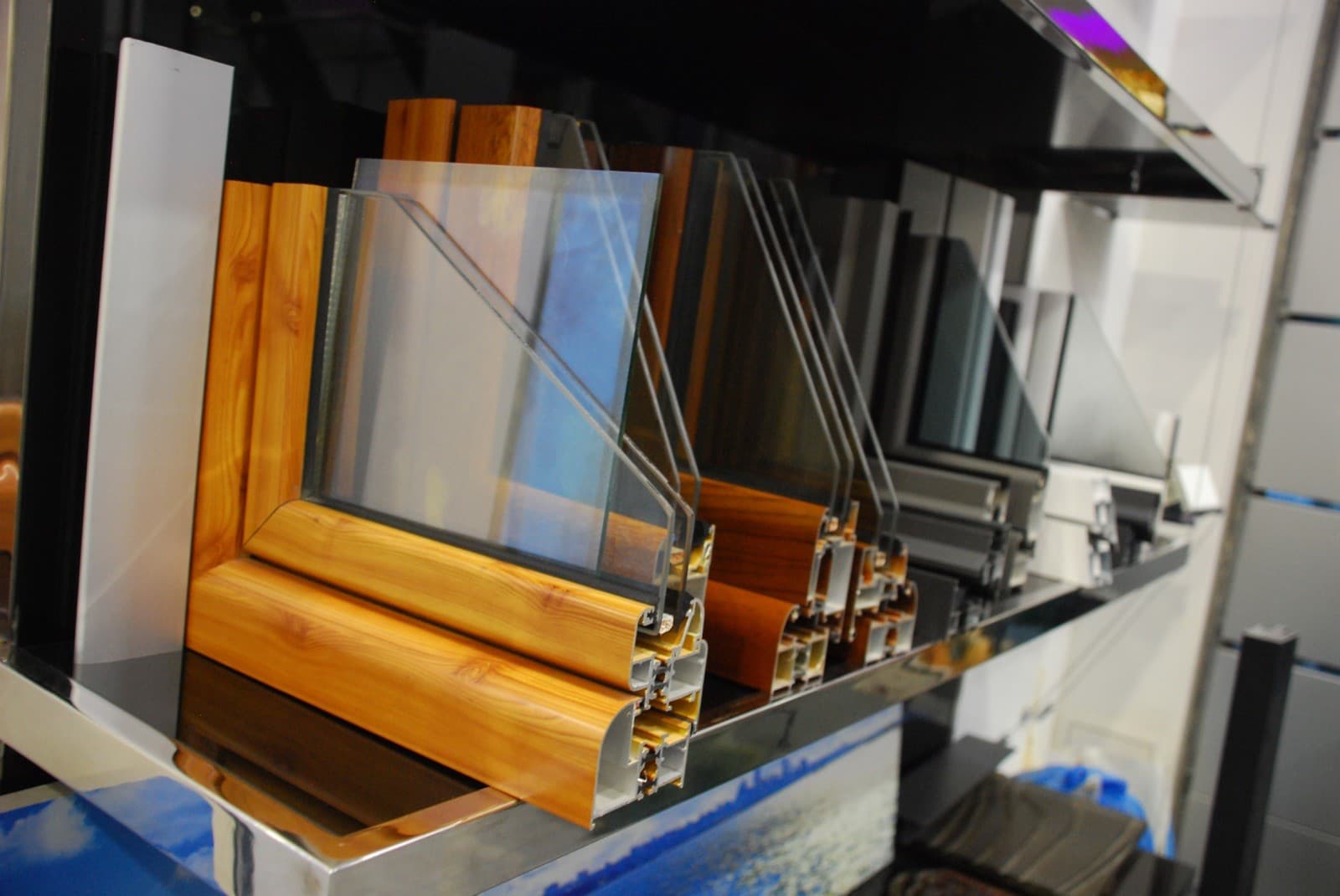
Aluminium is light, strong and durable, but it conducts heat very well. A solid aluminium profile acts like a radiator: in winter the inner frame surface cools almost to outside temperature, condensation forms and frost appears. That is why “cold” aluminium systems are only used where insulation is not needed — unheated rooms, partitions, internal shopfronts.
External envelopes use thermally broken profiles — “warm aluminium”.
How the thermal break works
A warm profile has three parts:
outer aluminium shell — takes the weather and carries the facade colour;
thermal break — a strip of low-conductivity polymer;
inner aluminium shell — forms the interior surface and can have a different colour.
The parts are joined at the profile factory by rolling: the insert is placed in grooves in the aluminium and crimped, creating a strong joint that works as one profile.
What the insert is made of
The most common material is polyamide PA66 reinforced with 25% glass fibre (PA66 GF25). The glass fibre makes the insert stiff and brings its thermal expansion close to that of aluminium, so the profile does not distort with temperature swings.
The thermal conductivity of this polyamide is a few tenths of a W/(m·K), while aluminium’s is well over a hundred. The insert conducts heat hundreds of times worse than the metal it separates. Manufacturers also offer foamed polyamide with even lower conductivity, and complex inserts with extra chambers.
What drives performance
Insert width. The wider the insert, the longer the heat path and the lower Uf. Deep series have wide inserts.
Shape and chambers. Chambers inside the insert reduce convection and radiation.
Insulating inserts. Foam inserts in the cavities between the strips further reduce Uf.
Centre gasket. Forms a separate chamber between frame and sash and blocks cold air.
Glass bite depth. The deeper the glass sits in the frame, the lower the edge losses.
For scale: an aluminium window frame without a thermal break has a Uf of about 6.8 W/(m²·K); with a 42 mm insulating profile, about 1.3 W/(m²·K).
Thermal break and condensation
For housing, not only Uf matters but also the inner surface temperature of the frame. DBN V.2.6-31 separately requires the inner surface temperature of glazed elements and thermal bridge zones not to fall below a permitted value — otherwise condensation and mould appear on reveals. The thermal break pushes the cold zone outwards and keeps the inner profile surface warm.
It is important that the plane of the thermal break lines up with the wall insulation. If the window sits in the cold zone of the opening, even the best profile will not stop reveals from freezing. Window position in the opening is a detailing question to be solved with the designer.
Thermal break and strength
The insert is part of the load-bearing section. Under load, the outer and inner shells work together only as far as the joint through the insert is stiff. Wind load calculations therefore take the joint properties into account, and system manufacturers test it in shear and tension.
Two-colour profiles
A welcome side effect of the thermal break is that the inner and outer halves can be coated in different colours — for example anthracite outside for the facade and white inside for the interior.
How to check profile quality
When comparing offers, look for a few practical signs:
Origin. A genuine system profile comes with a catalogue, calculations and test reports; undocumented “equivalents” may have different sections and inserts.
Marking. Profiles and thermal break strips from system manufacturers usually carry series and batch markings.
System documents. A declaration of performance with classes and Uf, and a calculation for your unit.
Joint quality. The shells must not shift relative to each other; the cut ends show an even, tight insert fit.
Finish. Uniform colour and coating thickness without runs; for facades, finish certification under a recognised quality scheme.
These checks do not replace laboratory testing, but they help weed out clearly weak offers at tender stage.
Summary
The thermal break is the key element of a warm aluminium profile. It governs Uf, inner surface temperature and condensation risk. When choosing a system, compare not only Uf figures but also build depth, insert design and the installation detail in the wall.
Detailed system data is in our catalogue.